
Property is delivering the most meaningful rate relief since 2017. Workers’ comp is the strongest it has been in years. Cyber and D&O have been buyer-favorable for several consecutive quarters. If your renewal falls in any of those lines, the window is open and the preparation you bring to market will determine how much of that relief you capture.
The other half of the story is less comfortable. General liability is carrying its highest Q3 incurred loss ratio in more than 15 years. Commercial auto is still climbing. Excess towers are absorbing the severity that liability lines are generating below them.
This is not a broad soft market. It is a segmented one. The buyers who benefit know which lines to push, when, and with what. The ones who treat this like a routine renewal cycle will leave money on the table.
Soft headlines don’t mean an easy renewal. Underwriters are verifying your data against third-party sources. Your submission narrative is doing more work right now than it has in years.
The capital came back. The lawsuits didn’t.
Capital and competition. Record reinsurance capacity and two consecutive years of strong insurer earnings have fueled significant competition, particularly in property. Insurers that pulled back from CAT-exposed accounts in 2022 and 2023 are re-entering selectively
A quieter 2025 catastrophe season. Global insured catastrophe losses came in around $107 billion against a projected $200 billion. That gap matters. It accelerated property pricing relief and gave reinsurers the confidence to expand capacity heading into 2026.
Social inflation. Larger jury verdicts and rising settlements remain the market’s defining liability challenge. Nuclear verdicts are becoming a pricing assumption, not an outlier. Liability-heavy accounts need to treat this as a structural condition, not a bad year.
Slower premium growth. Industry direct premium growth is projected to slow to roughly 4% in 2026, down from approximately 5% in 2025. Insurers are chasing volume in competitive lines, which is creating real opportunity for well-positioned buyers.
Line by line.
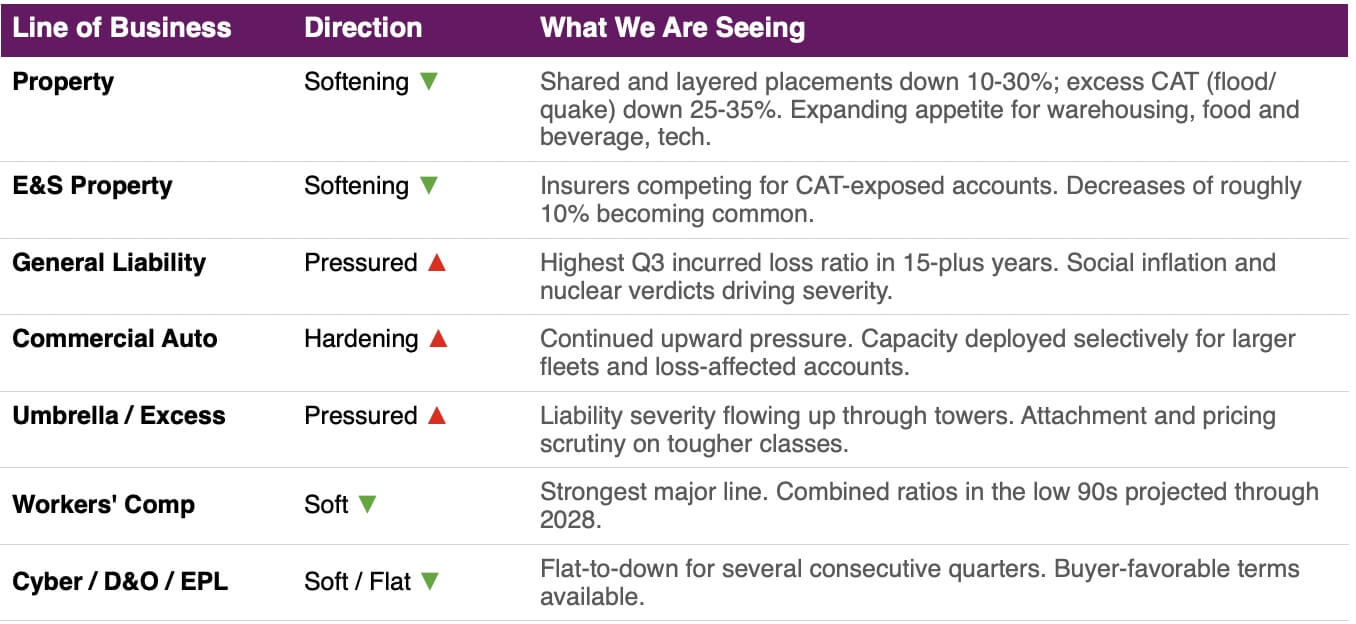
Sources: Triple-I/Milliman, Swiss Re Institute, M3 Insurance, IMA, and Risk & Insurance market reporting (January-June 2026). Figures are directional and vary by account size, geography, and loss history.
Where to push, where to be careful.
Property softening is the clearest opportunity this cycle. Portfolios that absorbed steep increases in 2022 through 2024 should be testing the market aggressively this renewal. CAT-exposed and habitational accounts are seeing the most pronounced relief in shared and layered placements and E&S lines. A current, well-documented statement of values and updated replacement cost estimates will materially improve outcomes. A 10% rate decrease does not help you if your replacement cost estimate is further off than that. Underwriters are not simply accepting broker valuations. The accounts with verified data are winning the best terms.
A mixed outcome is likely. Builder’s risk and property lines benefit from the softer environment. But GL and auto-heavy accounts will still face scrutiny, particularly where there is fleet exposure or recent liability losses. Submissions that lead with documented safety programs, telematics data, and loss-control history are differentiated in a way that pricing concessions alone cannot achieve.
Accounts with Liability Exposure
General liability, umbrella, and excess are the lines where preparation matters most and where the consequences of a thin submission are sharpest. Social inflation has fundamentally changed how underwriters model severity. The accounts that come to market with documented risk management, litigation management protocols, and a clear loss narrative are getting capacity. The ones that do not are getting priced accordingly.
Stable Wins to Lock In
Workers’ comp and cyber are delivering. Combined ratios in comp are projected to stay in the low 90s through 2028, and cyber pricing has been buyer-favorable for several consecutive quarters. If your program is renewing in these lines, the priority is locking in favorable terms before the market shifts, not waiting to see if it softens further.
The buyers who capture the relief this cycle are not waiting for renewal season. They are entering the market early, with a sharp narrative and verified data. That combination is outperforming rate alone.
Five decisions your team should be making right now.
- Start earlier than you think you need to.
The accounts capturing the most meaningful relief in property and E&S lines are entering the market 90 to 120 days out. Waiting for renewal season means competing for capacity that has already been committed. - Audit your statement of values before your underwriter does.
Third-party valuation tools and aerial imagery are now standard underwriter workflow. The submission that leads with verified replacement cost data wins, regardless of line. - Build a liability narrative, not just a loss run.
For GL, umbrella, and excess, underwriters are reading the story behind the numbers. Loss context, risk management programs, and litigation protocols are moving attachments and pricing. Silence on these points is not neutral. - Assess your fleet exposure explicitly.
Commercial auto is still hardening. Accounts with owned vehicles that have not recently documented their driver safety programs and telematics initiatives are leaving themselves exposed in renewal conversations. - Lock in favorable cyber and comp terms.
Buyers treating these renewals as transactions are leaving value behind. Both lines are positioned well right now. The question is whether your program is structured to hold that position through the next cycle.
Engage your broker before the market does.
Let Us Play For You!
Most renewal conversations start too late and aim too low. Contact your Symphony Account Executive or build@symphonyrisk.com or visit symphonyrisk.com/solutions/symphony-build to talk through your program before your renewal window opens.