
A qualification guide for middle-market general contractors
By Matt Burns, President, Symphony Build
Every hard market produces the same conversation. Premiums climb, options narrow, and someone mentions a captive. For some general contractors, that conversation leads somewhere real, but for others, it leads to a feasibility study, a year of meetings, and a structure that doesn’t fit.
Middle-market GCs in the $50M–$150M range are facing some of the most difficult casualty market conditions in years. Courts in construction-defect-heavy states – California, Colorado, Nevada, Florida, and Texas among them – have expanded the definition of an “occurrence” broadly enough that insurers price for a wide loss exposure and pull back capacity accordingly. Statutes of repose stretching 6–10+ years mean insurers are underwriting risk that may not materialize for a decade. The result is thin admitted-market appetite, heavy E&S reliance, high SIRs, and steep pricing – especially for residential, condo, and multifamily work. That pressure is what is driving aggressive captive promotion into this segment right now.
Captives are frequently oversold to contractors who aren’t ready for them. We wrote this to be the other conversation.
How a Captive Works
A captive is a licensed insurance company owned by the insured. Instead of paying premiums to a third-party insurer and walking away, you retain a meaningful share of your own risk – and with it, the underwriting profit and investment income that would otherwise stay with the market.
For the right GC, a captive is a multi-year capital strategy that rewards strong safety performance and disciplined operations. For the wrong one, it adds collateral obligations, governance demands, and volatility – without enough upside to justify any of it.
The hard part is that the “right GC” profile is narrower than most consultants will tell you.
Group vs. Single-Parent: Know the Difference
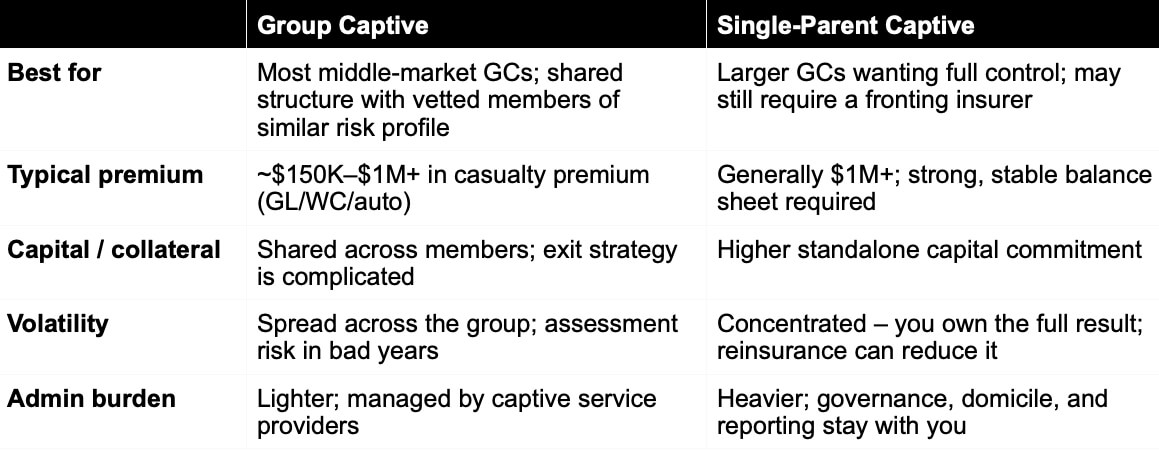
Most middle-market GCs are choosing between two paths: a group captive or a single-parent captive. These are not interchangeable.
A group captive pools premium and risk across a vetted membership – typically contractors with similar risk profiles and premium volumes. Capitalization is shared. Governance is lighter. The entry bar is lower. For GCs in the $150K to $1M+ casualty premium range, this is usually the more realistic starting point.
A single-parent captive is what it sounds like: you own the structure outright. Full control, full result. The economics generally require $1M or more in annual premium and a balance sheet that can absorb a bad year without strain. Reinsurance can reduce the volatility, but governance and collateral obligations stay with you.
For GCs in the $50M to $150M revenue range – the segment most aggressively targeted by captive promoters right now – a single-parent captive is rarely the right structure. If a captive makes sense at all for that tier, group is almost always the answer.
The Right Candidate
These are not arbitrary criteria. They are patterns drawn from what separates the captive programs that perform from the ones that don’t.
- Better-than-average loss history. GL and workers’ comp losses that run consistently below your peers. If you are performing well, the guaranteed-cost market is charging you to subsidize contractors who aren’t. A captive stops that transfer.
- Genuine risk-control discipline. Not a binder of safety policies – documented practices that show up in your loss runs. Subcontractor qualification. Disciplined OCIP and CCIP management. Claims that get managed, not just reported.
- Predictable, working-layer exposures. Premium volume that makes the economics work, and a balance sheet that can absorb a bad year without material impact. If a single loss event would cause real financial strain, the structure isn’t right yet.
- Multi-year commitment. A captive is a 3-5+ year capital play, not a one-renewal rate maneuver. GCs who enter looking for short-term relief almost always exit early – and early exits are expensive.
- Owner engagement. Captives perform in proportion to how seriously ownership treats them. Safety involvement, claims participation, annual meeting attendance – passive owners consistently underperform.
The economics of a well-run captive are real, but they require proof before they become a plan. A stamped, certified feasibility study — one that stress-tests your balance sheet and models how accretive the placement will actually be over time — gives you a defined roadmap. Without it, any projection a broker puts in front of you is a sales tool, not a forecast. That study typically runs $7,500 to $15,000. Spend the money.
When a Captive Is the Wrong Move
This is the conversation most feasibility studies don’t have early enough.
- Severity-driven or volatile loss history. If your losses are characterized by infrequent but large claims rather than predictable, working-layer frequency, the captive math gets difficult. Group captives in particular require that members not drag the pool.
- Heavy residential, condo, or wrap-up exposure. Construction-defect and completed-operations claims are long-tail by nature – meaning you can complete a project, exit coverage, and still have meaningful liability years later. Funding and reserving that tail inside a captive structure is genuinely difficult. This is the single most common disqualifier we see.
- Thin or strained balance sheet. Collateral requirements are real. Assessment risk in a group structure is real. If your liquidity is already constrained, a bad year inside a captive can create a cascade of problems.
- Short-term rate focus. If the motivation is avoiding a single hard-market renewal, the structure almost certainly won’t justify the entry cost and commitment. Captives work over time, not in a single policy period.
- Low appetite for engagement. Claims need active management. Loss control needs real investment. Contractors who treat a captive like a set-it-and-forget-it program don’t get the returns that justify the complexity.
The Disqualifier Most GCs Miss
The contractors most tempted by captives during a hard market – residential builders, wrap-up participants, condo developers – are often the least suited for them. Their exposure profile creates exactly the kind of long-tail, severity-driven risk that’s hardest to manage inside a captive. And by the time the completed-operations claims emerge, the contractor may have already exited the structure.
This doesn’t mean captives are off the table for every contractor with residential exposure. It means the analysis must be more careful, and the structure, if any, has to be designed around that tail. That is a different conversation than the standard feasibility study.
How Contractors Get Burned
A GC with $1M in annual casualty premium gets approached by a broker who says: you’re eligible for a captive. Year one, premium goes into the structure. The GC funds $1M, but only $600K is called upon. It looks like a win.
But then the claims come. The captive has reserve obligations. The loss ratio deteriorates. What looked like a $400K savings in year one turns into a $1.5M funding obligation in year two. The contractor can’t exit; the money is already committed and the claims are still open. Unwinding a captive is not like canceling a policy.
A single-parent captive in that scenario can genuinely threaten the financial stability of a $50M-$100M contractor. It has happened, but it is avoidable.
The safeguard is a stamped, certified feasibility study from an independent CPA – not the firm selling you the captive. If a broker skips that step, that is the signal.
Before You Decide Anything
For most middle-market GCs, the decision isn’t single-parent versus group. It’s whether a group captive is worth exploring at all – and what the construction-defect and completed-operations tail looks like before you walk in.
If your loss history is clean, your safety culture is real, and your exposures are predominantly in the working layer, the economics can work. If your losses are severity-driven or your completed-operations exposure is material, the traditional market is probably the right answer for now. The focus should be on positioning you to qualify for a captive in the future – not on entering one prematurely.
The captive conversation is worth having. It just shouldn’t start with the structure.
Our Approach
We run a no-obligation feasibility review that benchmarks your loss history, premium spend, and exposure profile against actual captive entry criteria. We will tell you honestly where you stand, including when the answer is “not yet” or “not this structure.”
If the fit is there, we have the relationships and technical depth to build it correctly. If it’s not, we’d rather tell you that now.
Contact your Symphony account executive or reach us at build@symphonyrisk.com. More at symphonyrisk.com.
Let Us Play For You!
symphonyrisk.com